
DOWNLOAD THE APP


Customer Services
Copyright © 2025 Desertcart Holdings Limited
DOWNLOAD THE APP
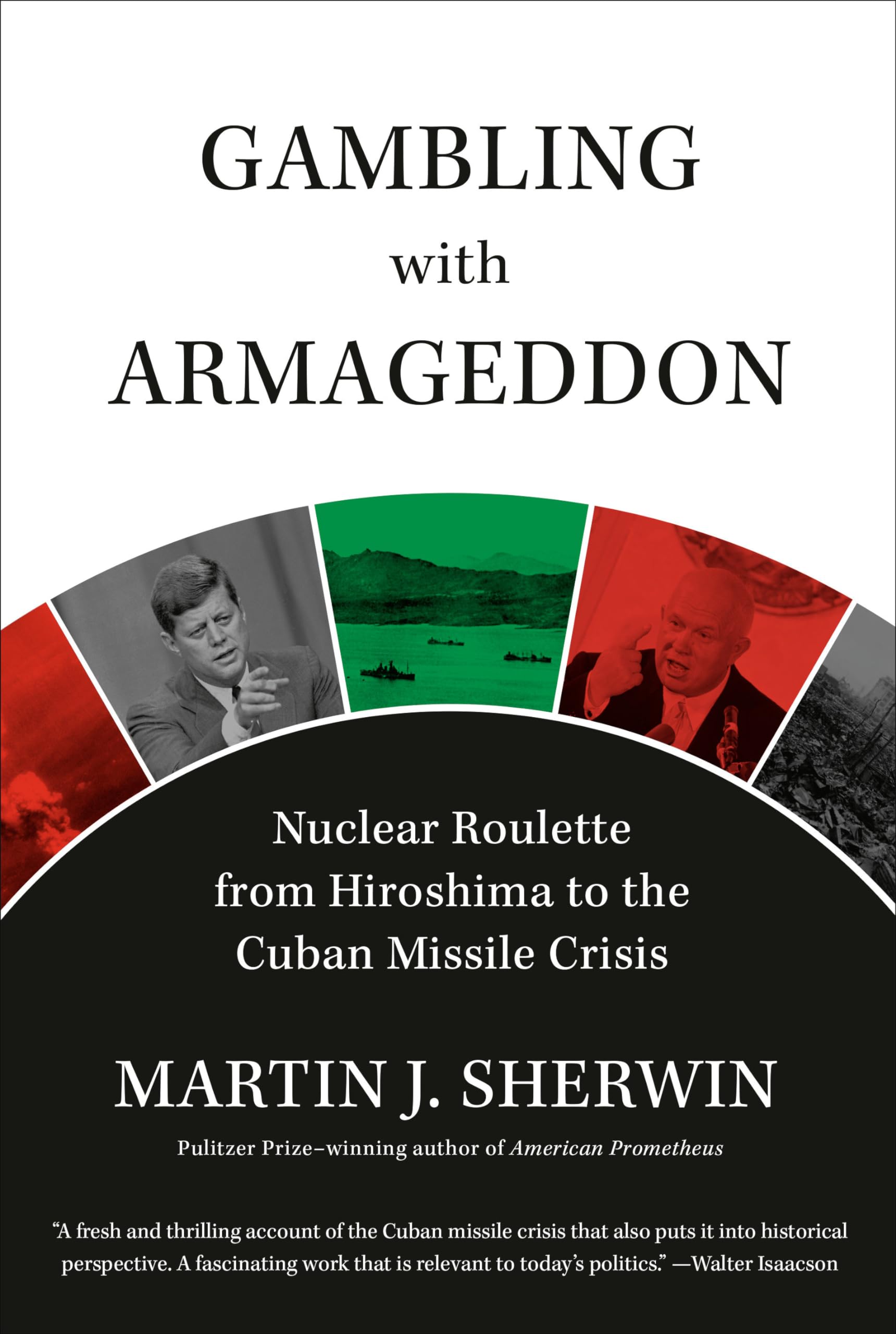
Gambling with Armageddon: Nuclear Roulette from Hiroshima to the Cuban Missile Crisis [Sherwin, Martin J.] on desertcart.com. *FREE* shipping on qualifying offers. Gambling with Armageddon: Nuclear Roulette from Hiroshima to the Cuban Missile Crisis Review: Excellent Update on a Trying Time - Sherwin has written an interesting review of the events surrounding the Cuban Missile Crisis. It is in a sense a minute-by-minute summary of what occurred over the period with commentary on previous recollections and written reports. In a sense the author is attempting to set the record straight based upon new information and first-hand reports. The book is exhaustive in its coverage of the period but does preface it with the work leading to Hiroshima and the Eisenhower period of dealing with Soviet nuclear expansion. Overall, the book is expansive and details the interaction of the key players who make both assumptions and policy, often devoid of reality. In a sense the book is pro-Kennedy, with the exception of the slight interruptions of his “assistants”, Fiddle and Faddle, who seem to play some unstated role. One sees Kennedy dealing with the conflicting advice from his multiple advisors as well as having to deal with the generally pro-war military. For the most part the story has been told many times but there are several issues which it raises. First is the generally gross incompetence of the Intelligence community, the CIA, who after the Bay of Pigs fiasco seem to have just dug a deeper whole for themselves. The CIA seems to have continued its fumbling over an extensive period of time. Second is the Military Officers in command whose blatant dislike of the civilian leadership. Neither seemed to have served the American people well. The book does raise some serious issues: 1. Did the Executive and the Military have the faintest idea what damage could be brought by MT nuclear devices? No where in the discussion is there anyone telling Kennedy what may happen. These estimates were well known and circulated in DoD and the Executive. Millions of deaths would result in just a few seconds. These weapons would be 1,000 or more greater that Hiroshima (15KT), 2. Why was there no psychological profiles of Khrushchev and other Soviet leaders so that one could have some understanding on how to deal with them and moreover why they did what they did? Despite the alleged attempt by Kennedy to try to understand Khrushchev there did not seem to have been any detailed profiling of the individuals nor any attempt to understand why they were doing what they were. This was another defect at the CIA then and I suspect now. 3. Why did no one in the US side even realize that if they tried to neutralize the nuclear sites there would always be one or more unseen which would then be launched? This I have called the “cancer surgeon metaphor”. Namely the surgeon can remove what the surgeon sees, yet unseen malignant cells result in terminal metastasis. The author recalls the Rumsfeld comment of “Known knowns” etc. The author clearly indicates that Rumsfeld “folly” was his matrix of perception vs reality had four entries, and it was missing fourth the bit him. 4. The “loose cannon” problem. This is the problem of having some low-level office in charge of deploying a nuclear weapon doing so on their own initiative. In Ellsberg recent book he details a multiplicity of these occasions. Namely launch authority could be accomplished well below the Executive. The author does and exceptionally good job in detailing the facts as are know and it is done in a highly logical and accessible manner. Very well worth the read. Review: This is Outstanding - Whoh......how close we came. This book is absolutely fabulous for anyone who is a student of the JFK era and the Cuban Crisis. Incredibly researched and thorough it is a terrific read on the Cuban crisis and the JFK Presidency. I learned much about exactly how close we came and the heretofore stifled role played by Adele Stevenson. He was far more instrumental in the outcome than other accounts have indicated. Great book and am going to read it again.


| Best Sellers Rank | #133,764 in Books ( See Top 100 in Books ) #48 in Nuclear Weapons & Warfare History (Books) #51 in Conventional Weapons & Warfare History (Books) #2,617 in United States History (Books) |
| Customer Reviews | 4.6 out of 5 stars 269 Reviews |
D**Y
Excellent Update on a Trying Time
Sherwin has written an interesting review of the events surrounding the Cuban Missile Crisis. It is in a sense a minute-by-minute summary of what occurred over the period with commentary on previous recollections and written reports. In a sense the author is attempting to set the record straight based upon new information and first-hand reports. The book is exhaustive in its coverage of the period but does preface it with the work leading to Hiroshima and the Eisenhower period of dealing with Soviet nuclear expansion. Overall, the book is expansive and details the interaction of the key players who make both assumptions and policy, often devoid of reality. In a sense the book is pro-Kennedy, with the exception of the slight interruptions of his “assistants”, Fiddle and Faddle, who seem to play some unstated role. One sees Kennedy dealing with the conflicting advice from his multiple advisors as well as having to deal with the generally pro-war military. For the most part the story has been told many times but there are several issues which it raises. First is the generally gross incompetence of the Intelligence community, the CIA, who after the Bay of Pigs fiasco seem to have just dug a deeper whole for themselves. The CIA seems to have continued its fumbling over an extensive period of time. Second is the Military Officers in command whose blatant dislike of the civilian leadership. Neither seemed to have served the American people well. The book does raise some serious issues: 1. Did the Executive and the Military have the faintest idea what damage could be brought by MT nuclear devices? No where in the discussion is there anyone telling Kennedy what may happen. These estimates were well known and circulated in DoD and the Executive. Millions of deaths would result in just a few seconds. These weapons would be 1,000 or more greater that Hiroshima (15KT), 2. Why was there no psychological profiles of Khrushchev and other Soviet leaders so that one could have some understanding on how to deal with them and moreover why they did what they did? Despite the alleged attempt by Kennedy to try to understand Khrushchev there did not seem to have been any detailed profiling of the individuals nor any attempt to understand why they were doing what they were. This was another defect at the CIA then and I suspect now. 3. Why did no one in the US side even realize that if they tried to neutralize the nuclear sites there would always be one or more unseen which would then be launched? This I have called the “cancer surgeon metaphor”. Namely the surgeon can remove what the surgeon sees, yet unseen malignant cells result in terminal metastasis. The author recalls the Rumsfeld comment of “Known knowns” etc. The author clearly indicates that Rumsfeld “folly” was his matrix of perception vs reality had four entries, and it was missing fourth the bit him. 4. The “loose cannon” problem. This is the problem of having some low-level office in charge of deploying a nuclear weapon doing so on their own initiative. In Ellsberg recent book he details a multiplicity of these occasions. Namely launch authority could be accomplished well below the Executive. The author does and exceptionally good job in detailing the facts as are know and it is done in a highly logical and accessible manner. Very well worth the read.
J**S
This is Outstanding
Whoh......how close we came. This book is absolutely fabulous for anyone who is a student of the JFK era and the Cuban Crisis. Incredibly researched and thorough it is a terrific read on the Cuban crisis and the JFK Presidency. I learned much about exactly how close we came and the heretofore stifled role played by Adele Stevenson. He was far more instrumental in the outcome than other accounts have indicated. Great book and am going to read it again.
L**S
Rich With Detail and Information
This is a marvelous book on a particularly perilous time during the Cold War. If you’re a lay-person - such as myself - just wanting an overview on the lead up the crisis, the contents of meetings in the White House and the Kremlin, etc. then this is the book for you. My only complaints are that (1) it can seem repetitive; and (2) can be a bit dry in some areas. Other than that, 95% of the book is a total page-turner.
E**E
Livingn on the edge of annihilation.
Outstanding research! Well written, this should literally be required reading. It is interesting, engaging, insightful, and more than a little sobering in an age more fraught with danger of annihilation than we are aware.
K**E
Best Book on Cuban Missile Crisis
This is the most detailed and insightful treatment of the Cuban Missile Crisis I have read. Written by my Dartmouth 1959 classmate. I was on a Navy destroyer as CIC Officer doing anti-submarine training from 1959-1962, leavinb in June just before my ship participated in the quarantine. Karl Holtzschue, LT USNR
D**E
Excellent book
Purchased for my hubby who is into history books. He highly recommends it and is enjoying it immensely. Highly recommend the author
P**D
Clear picture……good
I was spiritual moved
D**E
Opens your eyes to how the international sausage is made
This book is the well-written story of the Cuban Missile Crisis, including all the information that came to light years and decades later. It is suspenseful and dramatic, only because it clearly and calmly walks you through the crisis and the decisions and events that set the stage for it, which puts you front and center to watch how close we all came to watching the world burn.
Trustpilot
3 weeks ago
1 month ago