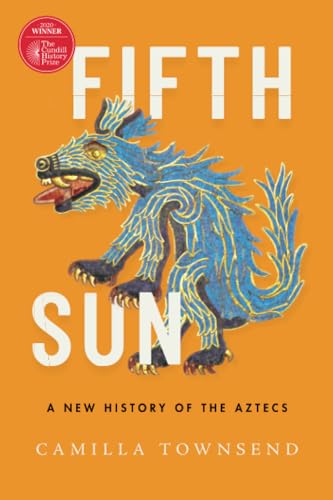


desertcart.com: Fifth Sun: A New History of the Aztecs: 9780197577660: Townsend, Camilla: Books Review: Lucid and engrossing - The best histories are those that upend everything you were taught in history class. With Fifth Sun, Camilla Townsend has offered a powerful, intelligently written overview of the people of central Mexico. (Erroneously called Aztecs, more on this below). A reader of this book will come away with a new understanding of their remarkable history. Often in discussions this period, the Spanish conquest plays a central role in the story. Obviously that history is presented here. The violence done to the inhabitants of central Mexico though, is frequently seen as almost an erasure, or annihilation of their culture. As Prof Townsend documents, while suffering catastrophic losses to the disease, killings and enslavement by the Spaniards, these people did not disappear. Their culture and language live on. (She helpfully presents an easy-to-understand primer of local pronunciations, including for Mexica, the people of the Valley of Mexico). The violence done even extended to their names. The word 'Aztec' we learn, was fabricated by European scholars centuries after the conquest. Townsend flatly notes : "No people ever called themselves that." She also puts the lie to several myths involving the Mexica, such as their understanding of their religion, and of the Europeans themselves. The idea that the Mexica viewed Hernan Cortes and the other Spaniards as the incarnation of their gods, was a story cooked up by the Europeans (Prof Townsend includes an appendix listing the primary sources). Each chapter is like a window into a world of a people on the verge of catastrophic change. Highly recommended. Review: Probably the best work of history I've read - Coming from someone who is currently a 4th year history student, I can undoubtable say that this is probably some of the best historical scholarship I have ever read. This piece is objective, does little to produce narrative (in the sense that it doesn't seek to vilify the Spanish or demonize the indigenous groups of Mexico). In terms of historiography, Townsend sort of flips back and forth from modern to post-modern. She will disprove aspects of the Spanish account, often by the use of indigenous records (very cool) and sometimes use outside or anthropology to tie the story together. This book reads quite easily, especially compared to other historical pieces I have read. In this sense, Townsend doesn't just produce a thesis and ramble on about it for 200 pages. This book is a great way to gain a sense of perspective from the indigenous point of view. In terms of research, it is accredited from the point that Townsend is a real professor- not just some random person spewing their ideals on this. For comparison, this book aligns with my upper division Latin American studies class I took, so the scholarship is accurate and on point. Definitely worth the read for anyone who is seeking to learn more about indigenous thinking and way of life.


| Best Sellers Rank | #26,963 in Books ( See Top 100 in Books ) #2 in Aztec History #6 in Mexico History #31 in Native American History (Books) |
| Customer Reviews | 4.6 4.6 out of 5 stars (1,208) |
| Dimensions | 5.4 x 0.9 x 8.2 inches |
| ISBN-10 | 0197577660 |
| ISBN-13 | 978-0197577660 |
| Item Weight | 2.31 pounds |
| Language | English |
| Print length | 336 pages |
| Publication date | July 1, 2021 |
| Publisher | Oxford University Press |
W**N
Lucid and engrossing
The best histories are those that upend everything you were taught in history class. With Fifth Sun, Camilla Townsend has offered a powerful, intelligently written overview of the people of central Mexico. (Erroneously called Aztecs, more on this below). A reader of this book will come away with a new understanding of their remarkable history. Often in discussions this period, the Spanish conquest plays a central role in the story. Obviously that history is presented here. The violence done to the inhabitants of central Mexico though, is frequently seen as almost an erasure, or annihilation of their culture. As Prof Townsend documents, while suffering catastrophic losses to the disease, killings and enslavement by the Spaniards, these people did not disappear. Their culture and language live on. (She helpfully presents an easy-to-understand primer of local pronunciations, including for Mexica, the people of the Valley of Mexico). The violence done even extended to their names. The word 'Aztec' we learn, was fabricated by European scholars centuries after the conquest. Townsend flatly notes : "No people ever called themselves that." She also puts the lie to several myths involving the Mexica, such as their understanding of their religion, and of the Europeans themselves. The idea that the Mexica viewed Hernan Cortes and the other Spaniards as the incarnation of their gods, was a story cooked up by the Europeans (Prof Townsend includes an appendix listing the primary sources). Each chapter is like a window into a world of a people on the verge of catastrophic change. Highly recommended.
M**Y
Probably the best work of history I've read
Coming from someone who is currently a 4th year history student, I can undoubtable say that this is probably some of the best historical scholarship I have ever read. This piece is objective, does little to produce narrative (in the sense that it doesn't seek to vilify the Spanish or demonize the indigenous groups of Mexico). In terms of historiography, Townsend sort of flips back and forth from modern to post-modern. She will disprove aspects of the Spanish account, often by the use of indigenous records (very cool) and sometimes use outside or anthropology to tie the story together. This book reads quite easily, especially compared to other historical pieces I have read. In this sense, Townsend doesn't just produce a thesis and ramble on about it for 200 pages. This book is a great way to gain a sense of perspective from the indigenous point of view. In terms of research, it is accredited from the point that Townsend is a real professor- not just some random person spewing their ideals on this. For comparison, this book aligns with my upper division Latin American studies class I took, so the scholarship is accurate and on point. Definitely worth the read for anyone who is seeking to learn more about indigenous thinking and way of life.
A**1
very enlightening
This is a very enlightening book. While it is a history, there is some attempt to depict what life was like, based primarily on written sources rather than all the tools modern archaeologists utilize. Interestingly, the Aztecs (or Mexica as a preferred name) themselves, post conquest, were the main sources of these writings –having become literate in Spanish, these amateur historians wrote accounts based on the oral histories and stories which existed. What I thought I knew about the Spanish conquest was mostly erroneous. Moctezuma had a realistic understanding of the Spanish and their superior weaponry, and felt he could not afford even a successful battle because of all the men it would cost, and the impact such a loss would have on the conquered tributaries. Townsend likens the warfare to the medieval polities taking on the cities of ancient Mesopatamia, as history/civilization in the Western hemisphere began so much later than in the rest of the world. As it was, the native American allies of the Spanish were motivated by a desire to be on the winning side as well as a desire to overthrow the Aztecs. Not long after Moctezuma’s murder, the occupants of Tenochtitlan (Aztec capital) did rebel, killing most of the Spanish in the city, and (temporarily) driving the rest out. The Aztec empire lasted only about one century, expanding throughout that time. Moctezuma instituted more direct control of the subject peoples than had previously existed. At first human sacrifice involved relatively few victims, and was very religious in spirit, although later it was used more as spectacle and to terrorize subjects. Tenochtitlan was a beautiful city of gardens, flowers, exotic birds in cages, song and dance. There were skilled tradesmen and merchants and far flung trade, using commercial polities protected from conflict. “Throughout Mesoamerica, it was understood that the children of enslaved women were never slaves themselves”. In the world of which the Aztecs were a part succession was based on competence, respect and political compromise among the leading families rather than first born, but civil war was not uncommon, with factions often allying with other polities. The Aztecs were Spartan with adolescent boys trained as warriors in Temple run schools. Surprisingly to me, the initial smallpox plague killed “only” 1/3 of the inhabitants of Tenochtitlan, but the native Americans were subject to recurrent plagues. The Spanish became successively greedier, impoverishing them to greater and greater extents. A final word on Townsend’s approach. I enjoyed her sketches of various historical figures, especially Cortes’ translator who played such a pivotal role. However, a more linear organization of the material might have been better, and I would recommend to those starting the book that they consider first reading the wiki article on Aztec history: it helped me clarify some of my notes.
A**K
Interesting read
Interesting book on Aztec and Spanish conquest history
J**S
All Good
D**0
Muy interesante historia..
J**S
Sinds mijn jongensjaren was ik gevaccineerd door de Midden-Amerikaanse culturen. Het fascineerde me hoe steden als Tenochtitlán floreerden, hoe rituelen, kunst en politiek met elkaar verweven waren, en hoe de verhalen van krijgers en priesters een diep inzicht gaven in hun wereldbeeld. Fifth Sun: A New History of the Aztecs heeft deze fascinatie nieuw leven ingeblazen. Davíd Carrasco slaagt erin een meeslepend en toegankelijk overzicht te geven van de Azteekse beschaving, van hun oorsprong tot hun tragische val. Wat dit boek bijzonder maakt, is de combinatie van archeologische vondsten, codices en mondelinge tradities, waardoor de Azteken niet langer abstracte figuren in een geschiedenisboek zijn, maar levende mensen met dromen, angsten en strategische briljantheid.
M**R
This book looks at the history of the Aztecs, the Mexica, as they called themselves, before, during and after the Spanish invasion. Based on histories deliberately written by indigenous people who lived shortly after the events, to ensure a record for future generations, this book gives the perspective and understanding of the Mexica about what was happening to them. These works were written to capture and preserve the oral histories and songs which had provided the original communities with their historical culture and identity. They have formed the basis for the author’s research and this fascinating book. It is clear that the Aztecs themselves had built their own own hegemony on violence and conquest and that this history eventually provided the Spanish invaders with the indigenous allies without whom they could not have hoped to prevail. This book also makes clear that some of legends which arose from the writings of the conquistadors are simply untrue - the Mexica did not believe that the Spanish were gods, and Mocezuma did not give his empire away willingly. This book brings the 15th and 16th century Mexica to life - their loves, fears, courage and defeats. It deals with their beliefs, with human sacrifice, and with the atrocities perpetrated by the conquistadors, and the devastating impact of diseases against which the Mexica had no immunity. All of this makes for a fascinating read. The book is written in an engaging style for the general reader, and with a vast store of notes and references for academic purposes and further reading. Highly recommended if you have an interest in Latin America or in history more generally.
M**E
Brilliant construction of hidden and tragic history.
Trustpilot
2 months ago
1 month ago


