

🚫🦟 Fast-Track Your Mosquito-Free Oasis!
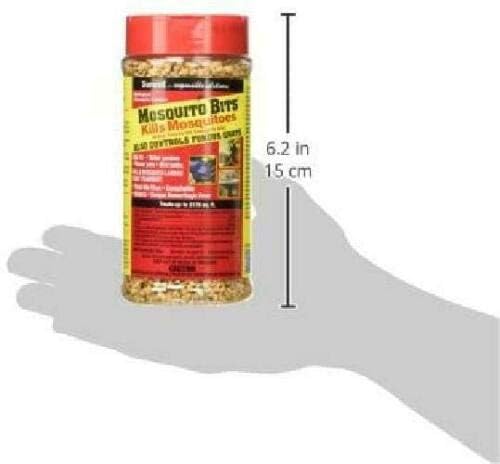
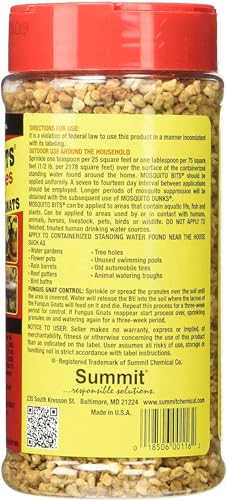
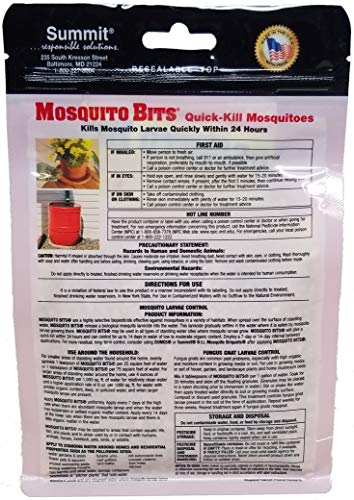
Summit 116-12 Quick Kill Mosquito Bits deliver a powerful, EPA-registered biological solution that kills mosquitoes and larvae within 24 hours. Using Bacillus Thuringiensis israelensis, these eco-friendly bits are safe for use in any standing water and come in a convenient 8-ounce size, making them the go-to choice for millennial professionals seeking effective, responsible pest control.
| ASIN | B0001LE1VC |
| Best Sellers Rank | 19,604 in Garden ( See Top 100 in Garden ) 241 in Indoor Multi-Insect Control |
| Customer Reviews | 4.3 4.3 out of 5 stars (985) |
| Date First Available | 25 Jun. 2008 |
| Department | Unisex-Adult |
| Ingredients | Bacillus Thuringiensis Subspecies Isrealensis Primary Powder Aedes Aegypti (Aa) International Toxic Units (Itu) Per Milligram Primary Powder. |
| Item display height | 3 inches |
| Item display length | 3 inches |
| Item display weight | 454 g |
| Item display width | 6 inches |
| Item model number | 116-12 |
| Item volume | 8 Fluid Ounces |
| Manufacturer | Summit...reponsible solutions. |
| Material type | Plastic |
| Part number | 116-12 |
| Power source type | Manual |
| Product Dimensions | 14.99 x 6.86 x 6.6 cm; 226.8 g |
S**R
Fungus gnats gone
Absolutely amazing product! I bought a peace lily plant, which is very beautiful and thrives wonderfully, giving me bloom after bloom. However, it was also badly infested with fungus gnats. I watered it once with this product, and all the flies were gone. It’s been 4 months since, and they have never returned. I’m so happy I bought this item. It’s expensive, but definitely worth the price.
H**S
This ended the fungus gnat war of 2019-2022. Get it for this problem. I implore you!
I was plagued with fungus gnats for the great war of 2019/21. They were everywhere in the house, buzzing around my head at night and in the day. At a glance, it didn't seem a big issue, but clearly, I underestimated the problem. I have a lot of house plants and thought I isolated the problem to a peace lily and aloe vera plant. In my naivety, I thought I could eradicate the problem by putting the plant in the cold, so out went the peace lily in the frost. The peace lily did not survive, but fungus gnats have natural antifreeze, so they carried on regardless. I read that Diatomaceous Earth would solve the issue, as the larvae like moist soil. I convinced myself this worked, but the odd gnat would still do a flyby. I then moved onto sticky yellow fly paper on all the plants, and it was then I became aware of the extent of the problem. The papers became covered in hundreds of gnats. Far more than I ever could have imagined. This reduced the issue, but the papers were still accruing more bodies daily. It was then I came across mosquito bites. It had been a long 18 months and I wasn't hopeful. I filled a watering can at the base with the pellets, and added water as directed. It gives off a foul sewer smell, but this smell doesn't travel, but is evident when you pour. After a couple of months of weekly watering, I noticed the reduction in gnats on the yellow paper, and this year I have yet to see a gnat. I declared the war over this summer. I have removed all the sticky yellow paper from the plant pots and have lived a gnat free existence since. The plants have thrived, I assume because the larvae are no longer eating the roots. I can heartily recommend this. I just wish someone had told me sooner, as I lost some good plants along the way.
S**H
Work well
Work well though not the silver bullet that j hear people refer to them as. Used for a fungus gnat problem
M**S
The only thing that actually works
I've learned much more about fungus gnats (sciarid flies) than I ever wanted to. Where do they come from? In my case, they were flitting in through an open window. But they can hitch a ride on anything that has soil. I've even spotted them around potted live herbs sold at my supermarket. The adults are teeny little suckers, but they can swoop in and drop a load of gnat eggs in a second--producing over 200 eggs in their short 2-week adult lifespan. If any of those eggs end up in your houseplant soil, you have a houseplant infested with gnat larvae (like minuscule maggots). They wriggle around in the soil, ravenously eating anything they can: fungus obviously--as their name implies--but also the delicate root tips of your poor plant! When the larvae are well-fed and ready, they pupate into adults, and the Circle of Life starts all over again, much to your horror. I wasted time trying a long series of mild and ineffective home remedies. Cinnamon? These bugs just yawned at the stuff. Neem oil? It made my sitting room smell like burnt tires, but the gnats weren't bothered a bit. Drying out the soil? This may be the worst thing you can do; as soon as the fungus dries up, those hungry larvae move on to the next available food source: the juicy, tender plant roots. Don't waste time on any of that. Sticky tape and cinnamon are not going to help you in a war situation. This product is more like a biological warfare agent on the gnat battlefield. No, literally, it is a bag of dried plant bits soaked in bacteria (Bacillus thuringiensis subspecies), which is lethal to the gnat larvae. Read the directions on the bag; they are very clear and easy to follow. You soak the dried plant bits in warm water to release and revive the bacteria; then, pour the resulting bacteria broth into the soil. The bacteria infects the larvae, and they die. This breaks the life cycle, so fewer adults will emerge from the soil after about a week. Don't let up, though; the adults still flying around are not affected by the bacteria, so they will still be busy dropping fresh batches of eggs. Hold your nerve and treat the soil again every week for about three or four weeks. By then, all the adults will have all died off (from old age), and any eggs left will have hatched, and any larvae will have become infected. It's not an instant solution by any means, but it is the only thing that actually works. I plan to keep treating my plants once a month or so from now on--the bacteria is harmless to the plants (and anything else that is not a gnat larvae), and you never know when one of those gnats might sneak in from outside or on a newly-bought plant friend.
F**T
They actually work.
Honestly wasn't sure these would work to deal with a insect problem in a houseplant (very tiny little bugs, not sure what). But combined with sticky pads to catch any that these didn't work on, it really did sort the problem out. It's a long time since I used them, and the problem hasn't recurred.
K**N
Houseplant use
First point: instructions are not the best. Measurements are US. As far as i figure for UK, 4 US tablespoons equals 60ml… and one US gallon is 3.8L There is no guidance on how much mixed solution to apply. I soaked my pots, which is ironic as this is the last thing you need for FN!! Soooo… second packet later, many repottings,(PS- sterilise your compost first - i microwave mine on high !! And wash old compost off roots then soak bare roots in super strong mosquito bits solution before repotting) about the eighth week of ‘soaking’ the pots with solution and loads of sticky traps i might be winning. Either way i’m not applying any more or the plants will die if root rot. I think it helps, but i needed to use other measures too and keep reapplying!!! Will try nematodes next if the problem resurges Update: several months later I gave up on this product. It did not eradicate the FG problem; only seemed to check them for a while before the next surge. I bit the bullet and repotted every plant (washing roots meticulously first) in either PON or LECA depending on plant/root size (seriously I had no idea… just went by feel!) Update: Dec 2025…. FG FREE since changing to non organic growing medium 😊
L**G
It works for fungus knats
Dealt with fungus knats easily
G**E
prodotto biologico che utilizzo nei sottovasi e dopo ogni pioggia dove ristagna l'acqua. Non è risolutivo ma aiuta a diminuire la presenza di zanzare, anche le zanzare tigre.
A**A
Good
C**N
Works great for fungus gnats. Need to soak for a minimum of 30 minutes and then water your plants after removing the kernels. Note, you need to do this once a week for three weeks (minimum) to break the life cycle of fungus gnats, as it kills the larvae and not the adults. It is not a one-use fix.
L**A
Mosquito bits are very effective at saving your plants from fungus gnats - and it successfully removed them all from my Monstera. You simply have to soak the mosquito bits in your plant water the next time you water for a minimum of 30 minutes. I then use a tea strainer to pull the bits out of the water - and then you have a beautiful tea to water your plants with that will kill larvae in the soil. ** Please note that the mosquito bits will effectively kill the larvae, but it will not kill flying fungus gnats - and they will simply lay more eggs. To effectively remove gnats, you need to pair the mosquito bits with yellow sticky fungus gnat traps to catch the adults. With this pairing, the mosquito bits will kill the larvae and the gnat traps will trap the adult gnats so they don’t lay more eggs. Happy Fungus Gnat eradication & good luck!
K**Y
This was a cure for my plant gnat misery and it worked in ONE DAY!
Trustpilot
1 week ago
2 weeks ago


